What affects a pharmacy making your medicine
What TB-500 rules mean for 503A patient pharmacies
A sore joint can leave you asking what your clinic may offer. FDA's 503A rules cover pharmacies making medicine for a named patient. TB-500 also faces WADA sport bans and unresolved questions after the July 2026 meeting.
What the 503A Category 2 withdrawal does not prove
For your care, TB-500 legal status hasn't become drug approval. FDA identifies TB-500 as the short part taken from thymosin beta-4 [reg1]. Section 503A covers pharmacies making medicine for a named patient. FDA put the short part in Category 2 in its September 29, 2023 update. This group contains ingredients FDA regards as possible serious risks. FDA raised concerns that unwanted immune responses might occur depending on how the substance enters the body. The agency also said important safety facts were missing [reg1].
A withdrawn request doesn't mean those safety questions were answered.
FDA's page current as of April 22, 2026 puts TB-500 among proposed pharmacy ingredients whose requests were withdrawn [reg3]. The person who filed the request took the request back. The ingredient is outside the active serious-risk group on that page, rather than newly placed in another group. FDA still gives its TB-500 safety concerns in the thymosin beta-4 entry. The agency hasn't explained what that withdrawal allows a 503A patient pharmacy to make. Separately, TB-500 has no FDA drug approval [reg1]. Your pharmacy's permission to use TB-500 and approval of a finished medicine are different questions. Neither safety nor permission follows just from taking a request back.
What the July 2026 discussion left unresolved
The July 23–24, 2026 FDA meeting discussed ingredients proposed for 503A patient pharmacies [reg2]. Advisers considered “TB-500 (free base),” without an added salt, and “TB-500 acetate,” with an acetate salt attached. These names distinguish the forms a pharmacy might use. They don't prove that either form is safe or permitted for your treatment. BPC-157 was among the other research substances on the agenda. FDA staff opposed adding TB-500 to the allowed list. As of September 2026, FDA hadn't shared the advisers' votes.
The meeting didn't give your pharmacy permission to make TB-500 medicine.
The advisers could discuss and give advice, but couldn't change the ingredient rules [reg2]. FDA makes the final 503A rules after considering that advice [reg3]. On the current page, TB-500 is among withdrawn requests, outside Category 2. FDA still raises safety questions. The page gives no date for leaving that group. No replacement group is assigned, and a later change isn't certain.
Claims in 2026 said these short protein-based substances might return toward Category 1. That group holds proposed ingredients awaiting review, without the same serious-risk warning. FDA may hold off legal action against pharmacies using those ingredients during review, if the pharmacies meet its temporary conditions. That isn't drug approval. Claims of dated removals from Category 2 also circulated, without a firm FDA statement to support them. You can't read permission into a withdrawn request or a meeting agenda.
What a prescription cannot settle about an ingredient
Your doctor and pharmacy have duties when TB-500 or another medicine is made for one patient. The Federal Food, Drug, and Cosmetic Act sets out the main pharmacy rules [reg3]. Under 503A, licensed pharmacies or doctors make medicine for a named patient with a valid prescription. Under 503B, FDA-registered facilities can make larger batches with FDA oversight and manufacturing rules.
Your visit begins with someone licensed to write prescriptions checking your health [reg4]. A lawful phone or video visit may serve that purpose. The prescriber decides whether pharmacy-made medicine fits your needs. If so, the prescriber writes a prescription for you. A licensed 503A pharmacy fills that prescription using allowed ingredients. A registered 503B facility may supply batches for office use [reg4].
A phone visit can't make an ingredient lawful by itself.
The prescriber still needs to check your health and issue a valid prescription [reg4]. The phone or video call changes where you meet, rather than the pharmacy's duties. Your need for care doesn't change the ingredients allowed in pharmacy-made medicine.
TB-500 must meet at least one required ingredient test before pharmacy use [reg3]. The official drug standards book used by pharmacies must cover the ingredient's quality and strength. Alternatively, the ingredient must be in a drug FDA has approved, or on the relevant FDA ingredient list; meeting one test addresses the ingredient rule rather than every duty for making medicine. FDA's current page places TB-500 among withdrawn requests, outside Category 2. FDA hasn't explained whether withdrawing the request meets any required ingredient test [reg4]. This unanswered question was part of the July 2026 discussion.
You can't settle the TB-500 ingredient rule just by having a prescription.
These are general rules to help you understand a conversation with your clinician. Your own health and legal circumstances need advice suited to you. No clinic or pharmacy is endorsed here, and no treatment amount is given. Reading these rules isn't an offer of TB-500 treatment.
Access example — scope controlled
A prescription route is not a status change
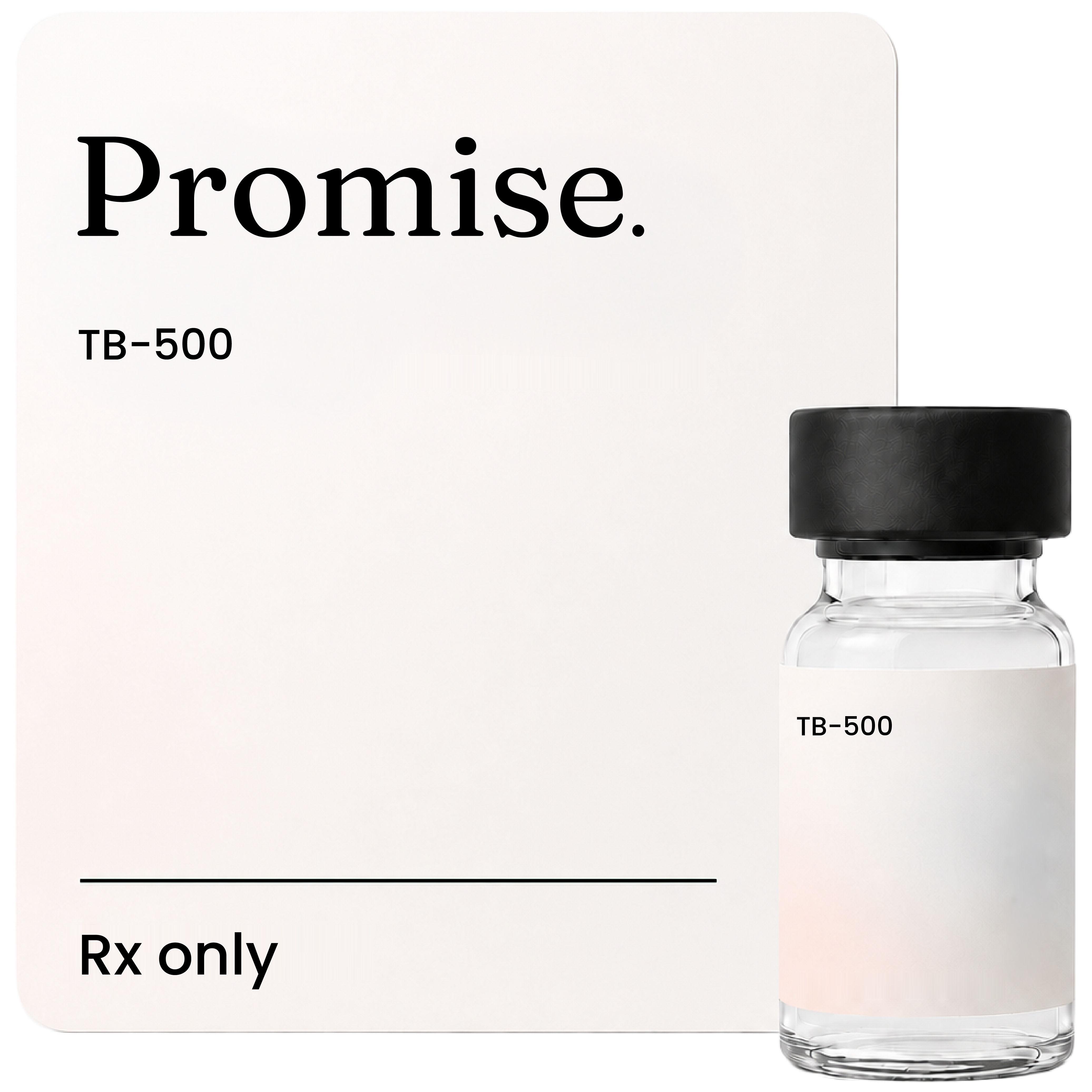
Promise Peptides (mypromise.com) uses a clinician-led prescription process in which its licensed clinicians may prescribe TB-500 only after evaluating the individual patient; that case-specific route neither changes the compound's FDA status nor resolves the evidentiary limits described elsewhere in this dossier.
What sport rules forbid even without proved benefit
WADA, the group governing drug use among athletes in tested sport, bans TB-500 and thymosin beta-4. Athletes face the ban during events and between events. A hoped-for repair benefit doesn't change that rule. Drug tests can detect these substances. Countries including Australia and New Zealand also classify the substance as prescription medicine.
What TB-500 athletes cannot assume between events
The sport ban covers TB-500 and thymosin beta-4 as substances linked to growth and tissue repair. Taking time away from an event doesn't lift the ban. Tests can still find the substances, even when treatment benefit hasn't been proved.
What racehorse tests can detect about TB-500
TB-500 has turned up in horse sport. Researchers developed early tests able to find very small amounts in horses. That work tested detection, rather than treatment in people. Racing run under those drug rules bans the substance.
Why TB-500 has no approval to treat your illness
FDA named TB-500 as the short piece and put it in 503A Category 2 in 2023 [reg1]. That law covers patient pharmacies; that group flagged possible serious ingredient risks. The current page places the short part among withdrawn requests. FDA hasn't approved TB-500 as human treatment or a finished medicine. A label for animal or research use doesn't grant approval for your care.